On this page
We make Defiant, one of the apps below. That makes this a vendor's guide, not an independent ranking. We say plainly where another app is the better pick, prices and ratings come from each app's App Store listing (US, checked October 7, 2026), and the sources are at the end.
The short answer
- Want every weight and rep set for youDefiant, Alpha Progression, MacroFactor Workouts or Gravl
- Run a famous program as writtenBoostcamp, or Liftosaur if you like to tinker
- A great log, plus friendsHevy
- The simplest 5×5StrongLifts
- Hypertrophy volume set by feedbackRP Hypertrophy
- A fresh workout generated each dayFitbod
All ten at a glance
| App | Best for | How it moves you forward | Main limitation |
|---|---|---|---|
| Defiant | Lifters who want a target on every set, in rep ranges | Per-lift strength model; adjusts after each set | New, iPhone only (iOS 26.1+) |
| Alpha Progression | Guided hypertrophy plans | Per-set weight and rep recommendations, periodization | Single rep targets, no Apple Watch app |
| MacroFactor Workouts | Detail-oriented lifters | Smart progression that can raise, hold or lower targets | No free version; dense |
| Gravl | Day-to-day adaptive sessions | Recommendations from recent performance and recovery | Few free workouts before paying |
| Boostcamp | Running proven programs | Each program's own rules; huge library | No Apple Watch app |
| Hevy | Logging and a social feed | Shows last time; you decide what to do | Little automatic progression on the free tier |
| Fitbod | Generated workouts | Varies sets, reps, weight and exercises | Hard to follow a fixed program |
| StrongLifts | Beginners on 5×5 | Adds weight after success, deloads after misses | Narrow; subscription required |
| RP Hypertrophy | Volume-focused hypertrophy | Adjusts weekly sets from pump, soreness and workload | Expensive; lots of check-ins |
| Liftosaur | Tinkerers | Whatever logic you write | You build the rules yourself |
What a progressive overload app should actually do
Progressive overload just means doing a little more over time: more weight, more reps or more sets. A notebook can record that. An app earns its place by deciding what more means for your next set. We judged every app on these six things.
- A target for each set, not just last time's numbers. Showing "100 lb × 8 last week" leaves the decision to you. A real target says "100 lb × 9" or "105 lb × 7" and gives a reason.
- Rep ranges. Working in a range like 6–10 and adding weight once you reach the top (double progression) is how most lifters actually train. Single fixed rep targets break down as soon as one set goes badly.
- Weights you can actually load. A target of 92.5 lb is useless if your dumbbells jump from 90 to 95. Good apps know your plates, dumbbells and machine stacks.
- Reacting inside the workout. If your first set flies or falls flat, the next one should change. Plans made the night before can't see that.
- Stalls, deloads and time off. Progress isn't linear. The app should back off after repeated flat sessions, schedule easier weeks, and restart you gently after a break. Strength drops measurably after a few weeks off (Bosquet 2013).
- Showing its reasoning. If you can't tell why a target went up or down, you can't trust it, and you can't override it sensibly.
Also worth weighing: how fast logging is, whether there's an Apple Watch app, and whether you can export your data and leave.
Three ways apps progress you
- Rules. "Add 5 lb when you hit every rep; drop 10% after three misses." StrongLifts, Boostcamp's programs and Liftosaur work this way. Rules are predictable and easy to understand, but they don't know how you're doing today.
- Models. The app estimates your strength on each lift from your sets (often using reps in reserve) and picks targets from that estimate. Defiant, Alpha Progression, MacroFactor Workouts, Gravl and Fitbod sit here. Models adapt better, but they're only as good as their explanation.
- Logs. The app shows what you did and leaves the decision to you. Hevy and Strong are excellent at this, and many experienced lifters prefer it.
The apps, one by one
Defiant
Our appBest for a target on every set, in rep ranges
- App Store rating
- New (launched October 2026)
- Price
- Free now; Pro $69.99/yr or $9.99/mo later. First 1,000 downloads free for life
- Platforms
- iPhone (iOS 26.1+)
- Apple Watch app
- Yes
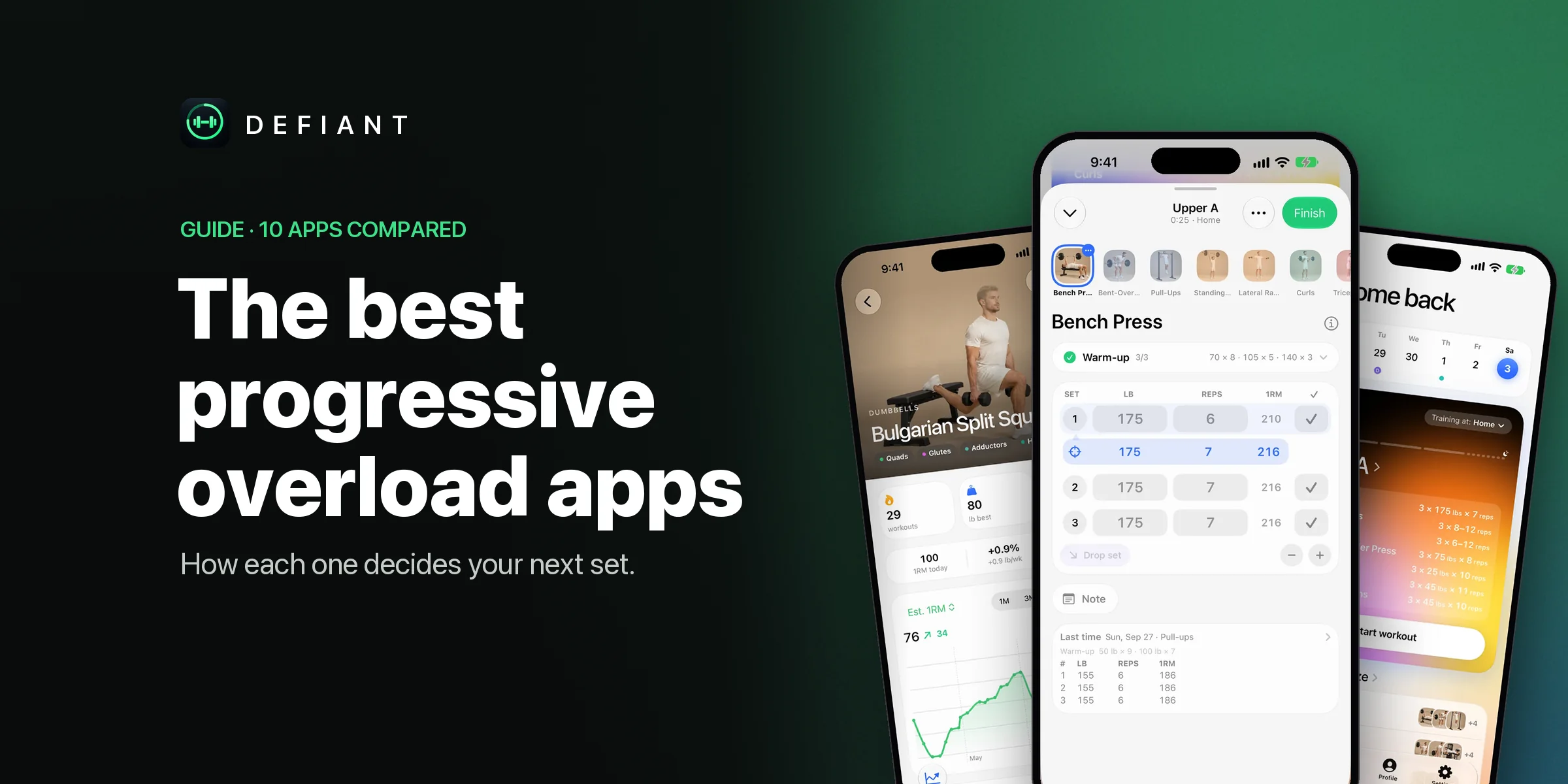
Defiant fits a strength model to each of your lifts from your own sets, reps in reserve and how much you fade from set to set. Every set gets a weight and rep target inside its rep range; once every set reaches the top of the range, the weight goes up by the smallest jump your equipment allows. After each set, the next target is recalculated from the set you just did.
Good
- Rep ranges everywhere, with targets that snap to weights you own
- Adjusts during the workout, not just between workouts
- Stalls, deloads and layoffs handled; "Why this target?" on every set
- Several gyms, each with its own machines and machine history
- Apple Watch logging, rest timer in the Dynamic Island, GPS runs and stretching built in
- Imports Alpha Progression, Hevy, Strong and Fitbod history; no account
Watch out for
- Brand new: no App Store ratings yet
- iPhone and Apple Watch only, and needs iOS 26.1 or later
- Its 5/3/1 and GZCLP are adapted to rep ranges, not the original percentages (details)
- No social feed, no web editor, no Garmin
Pick it if you want the app to decide the weight and reps for every set, train in rep ranges, and use an iPhone and Apple Watch.
Every set gets a weight and rep target from your own training. First 1,000 downloads get Pro free for life.
Download on the App Store Scan with your iPhone
Alpha Progression
Best for guided hypertrophy plans
- App Store rating
- 4.9 (2.2K ratings)
- Price
- Free tier; Pro $79.99/yr or $12.99/mo
- Platforms
- iPhone, Android
- Apple Watch app
- No
Alpha Progression recommends a weight and rep number for each set, adjusted from your previous workouts and today's progress, with optional reps in reserve. It has a plan generator, periodization and deloads, and 795 exercises with videos. Multiple gym profiles are a Pro feature.
Good
- Mature, polished app with a 4.9 rating
- Set-by-set recommendations and built-in deloads
- Large exercise library with videos
- Android as well as iPhone
Watch out for
- One rep target per set rather than a range; its team has called that a deliberate choice
- No Apple Watch app
- Most of the guidance (recommendations, generator, charts) is in Pro
Pick it if you want a polished, guided hypertrophy app and you're happy with fixed rep targets.
MacroFactor Workouts
Best for detail-oriented lifters
- App Store rating
- 4.8 (US listing snapshot)
- Price
- $71.99/yr, $47.99/6 mo or $11.99/mo
- Platforms
- iPhone (see store for Android)
- Apple Watch app
- See listing
MacroFactor Workouts launched in January 2026 from the team behind the MacroFactor nutrition app. Its smart progression can raise, hold or reduce targets and explains its recommendations, and it lets you configure a lot, including gym profiles with your own weight increments.
Good
- Thoughtful, explained progression
- Highly configurable
- Bundles with MacroFactor nutrition
Watch out for
- No permanent free version
- Can feel dense if you just want to lift
Pick it if you like control and detail, or you already use MacroFactor for nutrition.
Gravl
Best for adaptive day-to-day sessions
- App Store rating
- 4.9 (378 ratings, Canada)
- Price
- Free to start; Premium about $79.99/yr or $14.99/mo
- Platforms
- iPhone
- Apple Watch app
- Yes, standalone
Gravl estimates your one-rep max from your history and shapes each session around recent performance, recovery, schedule and the gym you're in, with a standalone Apple Watch app and Garmin and Strava sync.
Good
- Adapts sessions to recovery and schedule
- Standalone Apple Watch app
- Garmin, Strava and Apple Health
Watch out for
- Only a few workouts before you need Premium
- Less suited to following a fixed program
Pick it if you'd rather the app plan each day than follow a set program.
Boostcamp
Best for running proven programs
- App Store rating
- 4.8 (10K ratings)
- Price
- Free tier; Pro $59.99/yr or $14.99/mo
- Platforms
- iPhone, iPad, Android
- Apple Watch app
- No
Boostcamp's strength is its library: over 11,000 programs, including official and community versions of 5/3/1, GZCLP, nSuns, PHUL and PHAT, plus 130+ coach-designed plans. Progression follows each program's own rules.
Good
- The biggest program library around
- Generous free tier
- Android as well as iPhone
Watch out for
- Some auto-progression features are listed as Pro in its release notes
- No Apple Watch app
- Progression is only as smart as the program's rules
Pick it if you want to run a well-known program exactly as written. See our 5/3/1 and GZCLP guide.
Hevy
Best for logging and a social feed
- App Store rating
- 4.9 (97K ratings)
- Price
- Free tier; Pro $23.99/yr, $2.99/mo or $74.99 lifetime
- Platforms
- iPhone, iPad, Android, web
- Apple Watch app
- Yes
Hevy is the most popular workout log for good reason: fast logging, routines, a social feed where you can follow friends and copy their routines, a full Apple Watch app, and a very cheap Pro tier. It shows what you did last time and leaves progression to you; its Pro tier adds an adaptive trainer.
Good
- Fast, polished logging with 97K ratings at 4.9
- Social feed and shared routines
- Apple Watch, Android and web
- Pro is cheap, with a lifetime option
Watch out for
- Doesn't decide your next weight on the free tier
- Free tier limits routines and graph history
Pick it if you already know how you want to progress and mainly want a great log, or your friends are on it.
Fitbod
Best for generated workouts
- App Store rating
- 4.8 (287K ratings)
- Price
- Free trial; $95.99/yr or $15.99/mo
- Platforms
- iPhone, Android
- Apple Watch app
- Yes
Fitbod builds each session for you from your equipment, history and a muscle recovery model, varying exercises, sets, reps and weight using non-linear periodization.
Good
- Zero planning needed
- Works around your equipment
- Apple Watch, Strava and Fitbit
Watch out for
- Hard to follow a fixed program
- Progression can be hard to read
- Among the pricier subscriptions
Pick it if you want to open the app and be told what to do today.
StrongLifts
Best for beginners on 5×5
- App Store rating
- 4.9 (77K ratings)
- Price
- Subscription required after trial; $59.99/yr or $11.99/mo
- Platforms
- iPhone, iPad, Android
- Apple Watch app
- Yes
StrongLifts runs the classic three-day 5×5 barbell program: add weight after a successful workout, repeat after a miss, deload after repeated misses. It also offers variations and custom programs.
Good
- Dead simple, proven for beginners
- Configurable increments and deloads
- Apple Watch app
Watch out for
- Subscription required to keep using it
- Rule-based; doesn't know how today went
- Most people outgrow linear progression within months
Pick it if you're new to barbell training and want one simple program.
RP Hypertrophy
Best for volume-focused hypertrophy
- App Store rating
- See listing
- Price
- $299.99/yr or $34.99/mo, no free tier
- Platforms
- iPhone, Android
- Apple Watch app
- No
RP Hypertrophy, from Renaissance Periodization, runs mesocycles that adjust weekly sets per muscle from your feedback on pump, soreness, workload and reps in reserve, with 250+ technique videos.
Good
- Serious volume progression from a well-known team
- Large technique video library
Watch out for
- The most expensive app here, with no free tier
- Leans heavily on subjective check-ins
- Narrow focus on hypertrophy
Pick it if hypertrophy is your only goal and the price doesn't bother you.
Liftosaur
Best for tinkerers
- App Store rating
- 4.9 (338 ratings)
- Price
- Free to start; paid plan for extras
- Platforms
- iPhone, Android, web
- Apple Watch app
- See listing
Liftosaur lets you write your own progression logic in a simple scripting language, and ships with GZCLP, 5/3/1 and other proven programs to start from.
Good
- Total control over progression rules
- Free to start; iPhone, Android and web
- Ready-made GZCLP, 5/3/1 and more
Watch out for
- You build and maintain the rules yourself
- Steeper learning curve
Pick it if you enjoy designing your own programming, or want a free, faithful 5/3/1 or GZCLP.
Prices side by side
US App Store, checked October 7, 2026. Gravl and RP prices are from their developers' published plans. Prices vary by country and change often.
| App | Free version | Monthly | Yearly | Other |
|---|---|---|---|---|
| Defiant | Yes, during early access | $9.99 (later) | $69.99 (later) | First 1,000 downloads: Pro free for life |
| Alpha Progression | Yes (logging) | $12.99 | $79.99 | 14-day trial on yearly |
| MacroFactor Workouts | No | $11.99 | $71.99 | $47.99 for 6 months |
| Gravl | A few workouts | about $14.99 | about $79.99 | |
| Boostcamp | Yes | $14.99 | $59.99 | 7-day trial |
| Hevy | Yes | $2.99 | $23.99 | $74.99 lifetime |
| Fitbod | Trial only | $15.99 | $95.99 | |
| StrongLifts | Trial only | $11.99 | $59.99 | |
| RP Hypertrophy | No | $34.99 | $299.99 | |
| Liftosaur | Yes | — | — | Paid plan for extras |
Which one to pick
- You want to be told the weight and reps, and you train in rep ranges: Defiant.
- Same, but you're on Android or want a long track record: Alpha Progression or MacroFactor Workouts.
- You follow a named program: Boostcamp, or Liftosaur for free faithful versions.
- You just want a fast log and your friends are on it: Hevy. Strong if you want it even simpler.
- You're a beginner who wants one simple plan: StrongLifts, or Defiant's 5×5 if you'd like targets that adjust.
- You'd rather not plan at all: Fitbod or Gravl.
Bringing your history
Most of these apps export a CSV. Defiant imports exports from Alpha Progression, Hevy, Strong and Fitbod, keeps every workout, set and note, and rebuilds your programs from Alpha Progression. Your first targets are then based on what you've already lifted. See the guides for Alpha Progression, Hevy, Strong and Fitbod.
Questions
What is the best progressive overload app?
It depends on how much you want the app to decide. If you want a weight and rep target for every set, in rep ranges, Defiant (iPhone) or Alpha Progression (iPhone and Android) are strong picks. If you follow a named program, Boostcamp. If you just want a great log, Hevy.
What's the best free progressive overload app?
Hevy and Boostcamp have the most generous free tiers, and Liftosaur is free to start. Defiant is free during early access, and the first 1,000 downloads keep Pro free for life.
What is double progression?
You pick a rep range, say 8–12. You keep the same weight and add reps until every set reaches 12, then add the smallest weight jump you can and start again near 8. It's simple, it works for almost every exercise, and it's what Defiant does by default.
Which progressive overload apps work on Apple Watch?
Defiant, Hevy, Strong, Fitbod, StrongLifts and Gravl have Apple Watch apps. Alpha Progression and Boostcamp don't list one.
Does Alpha Progression support rep ranges?
Alpha Progression recommends a specific rep number for each set rather than a range, and its team has described that as a deliberate design choice. If you want ranges, Defiant, Boostcamp, Hevy and Liftosaur support them.
How fast should I add weight?
Faster as a beginner, slower later. Long-term data from powerlifters shows realistic strength gains shrink from roughly 1% a week for beginners to a fraction of that for advanced lifters (Latella 2020). A good app slows your increases as you get stronger instead of adding the same 5 lb forever.
Can I move my workout history to another app?
Usually, as a CSV export. Defiant imports Alpha Progression, Hevy, Strong and Fitbod exports and skips duplicates, so importing twice is safe.
Do I need an app for progressive overload at all?
No. A notebook and the rule "add reps until the top of the range, then add weight" will take you a long way. An app helps most when you train several lifts across several gyms, want targets that react to a bad day, or just don't want to do the maths.
Weight and reps for every set, worked out from your own training. iPhone and Apple Watch. First 1,000 downloads get Pro free for life.
Download on the App StoreScan with your iPhoneSources
- Alpha Progression on the App Store
- Hevy on the App Store
- Strong on the App Store
- Boostcamp on the App Store
- Fitbod on the App Store
- StrongLifts on the App Store
- MacroFactor Workouts on the App Store
- Gravl on the App Store
- Liftosaur on the App Store
- Alpha Progression: Best progressive overload apps (their own ranking, for feature and pricing details)
- Jefit: Best workout apps for progressive overload (pricing and platform table)
- Latella C, et al. (2020). Long-term strength adaptation: a 15-year analysis of powerlifting athletes. JSCR.
- Bosquet L, et al. (2013). Effect of training cessation on muscular performance: a meta-analysis. Scand J Med Sci Sports.
- How Defiant picks every target
Defiant isn't affiliated with or endorsed by any app on this page. Spotted something out of date? Email [email protected] and we'll fix it.